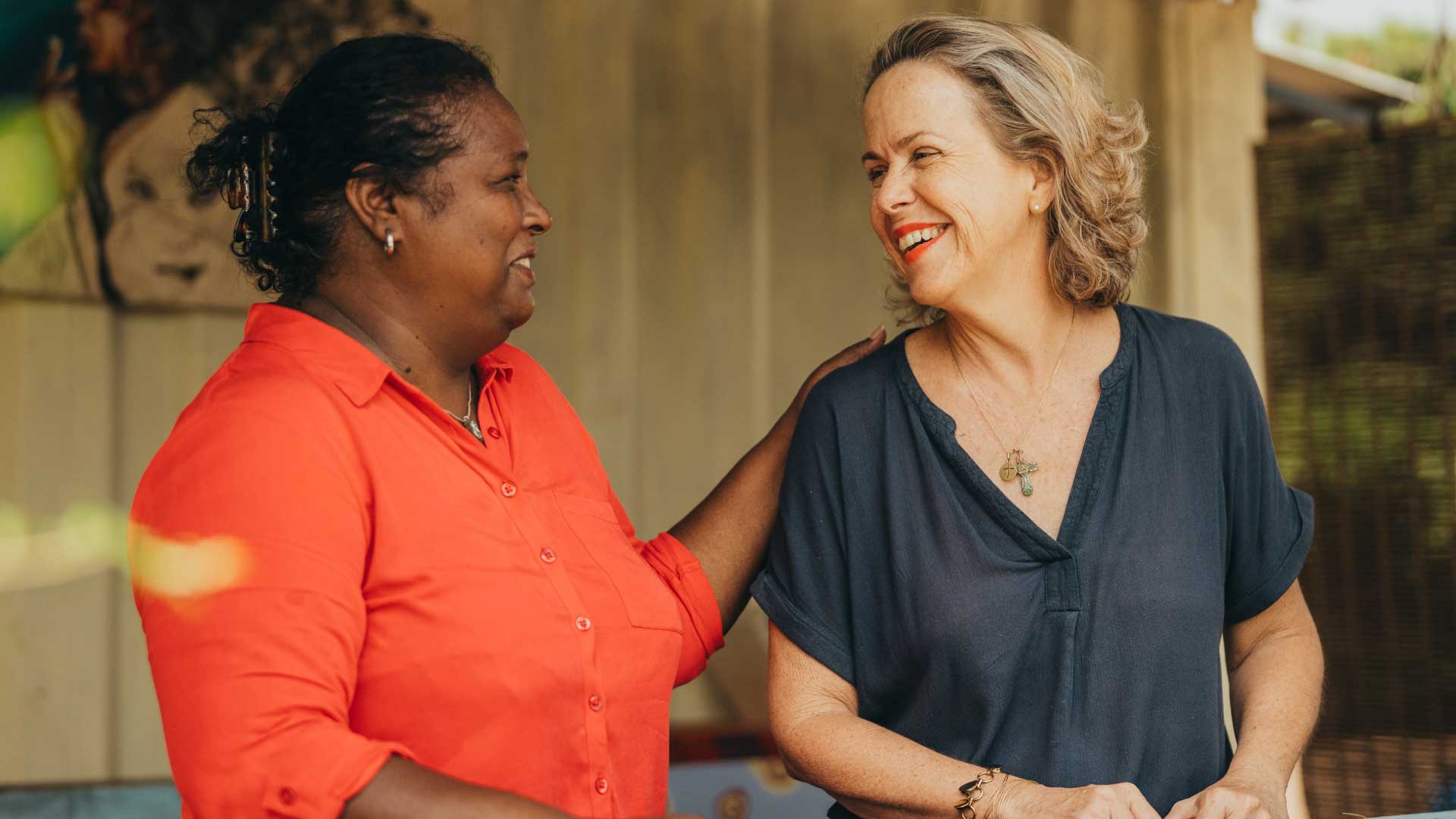
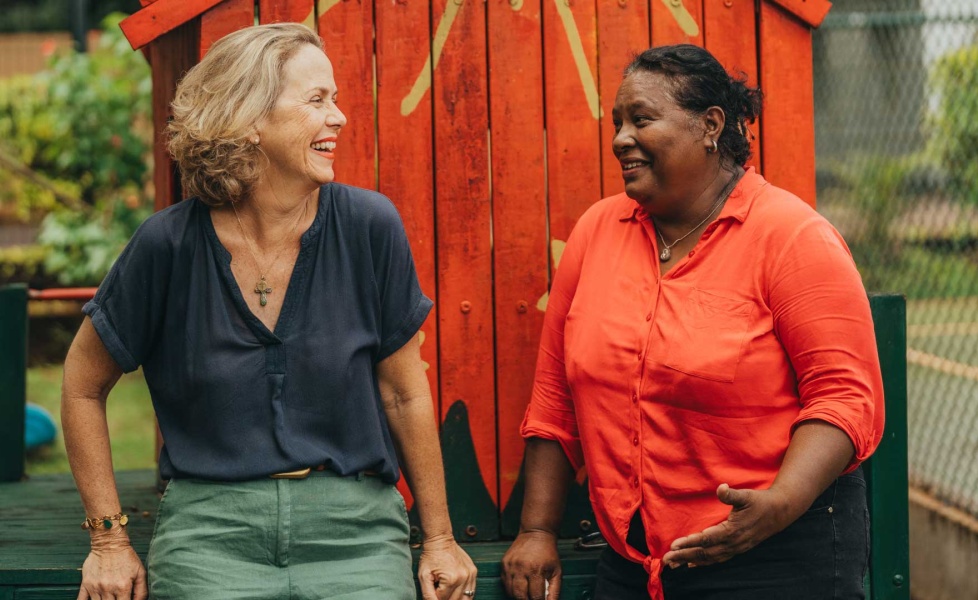
Lakaz Lespwar recently celebrated its fifteenth anniversary. This also marked the longstanding partnership with CIEL Foundation, a collaboration driven by a shared commitment to support the most vulnerable. In this interview, Delphine Bouic, Group Head of Community Engagement and Inclusion, and Christiane Pasnin, coordinator of Lakaz Lespwar, reflect on their shared journey and the importance of joining forces to create a lasting impact on the community.
About Lakaz Lespwar
Located in Solitude and run by Caritas Mauritius, Lakaz Lespwar is a community centre that assists families facing challenging circumstances through a holistic approach: listening, social support, educational activities, and training programmes. Since its creation, the centre has had a significant impact: over 4,250 direct beneficiaries have been supported, 325 children have attended the “Centre d’éveil” over 13 years, and the therapeutic community garden has benefited 350 women. Each year, the centre continues to reach young children from the age of five, with about 75 children engaged in educational and recreational activities.
How did the collaboration between CIEL Foundation and Lakaz Lespwar begin, and what made it possible?
Delphine: It all started 15 years ago when the CIEL Foundation was looking for a strong, meaningful project to invest in. I reached out to Caritas Mauritius, who was already overseeing the Lakaz Lespwar initiative. Everything was entirely new to us: the location, the concept of the centre, even the idea of using shipping containers as buildings!
Christiane, on her side, already had a vision for Lakaz Lespwar, and very quickly, a strong relationship of trust developed. We built the project step by step, starting small, which I believe is the key in social work. I came from a marketing background and knew very little about this field, so Christiane and the entire team on the ground taught me to understand the realities of the families we support. We have learned so much from each other, and that mutual learning is what makes our relationship so strong today.
Christiane: Our first meeting took place in the Salle d’Oeuvre of Notre Dame de L’Espérance in Solitude. At the time, we already had two projects running at Lakaz Lespwar: breakfast and lunch packs, and academic support for children. What we lacked was space to expand and develop additional services. Meeting Delphine helped us structure our ideas and give them a clear direction.
Looking back, we had all the ingredients: a project founded on the community, a committed partner, and beneficiaries who remained at the heart of everything. Within a year of reflection, organisation, and structuring, the project came to life. From the very beginning, there was a shared commitment to build a lasting partnership, and that commitment continues to guide us today.
What concrete changes have you observed among the families and children supported through this partnership?
Christiane: You can only truly measure impact after many years. Now, after fifteen years, I can say that the changes are remarkable. My initial goal was to strengthen the capacities of individuals, even when their life situations seemed complicated. Many arrived feeling withdrawn and discouraged, and our role was to help open doors within them. Today, I see the results: children who have grown into responsible adults, parents who have regained confidence, families stabilised.
I’ve also realised that without a basic material framework, a safe environment and decent conditions, nothing or very little can indeed flourish. This is why we have worked on both the environment and personal development. For example, one of our former beneficiaries, now a flight attendant, sponsors a child today. Another mother was able to work with peace of mind knowing her child was in a safe space. Even a young man who had been in prison returned simply to say thank you. These transformations, whether small or significant, are deeply encouraging. Yet the work continues.
Delphine: For me, the impact is both real and profound. Many people come back to thank us, sometimes years after benefiting from the project, and each story reminds us how much a life can be changed, even modestly. We quickly understood that poverty goes far beyond a lack of money: it erodes self-esteem, undermines confidence, and makes it hard to imagine a future. Without self-esteem, progress is almost impossible. That is why we have invested so much in the human dimension: nurturing trust and potential. What moves me most is witnessing the resilience of the beneficiaries and knowing that we never gave up, even during the hardest moments.
As a funder, it was crucial not to judge, but to accompany patiently and respectfully. Trust is built both ways: it grows through listening, consistency, and a sincere belief in every person’s ability to rebuild and move forward.
What lessons has Lakaz Lespwar learned from this collaboration to strengthen your organisation and actions on the ground?
Christiane: This collaboration has taught me discipline and focus. In this line of work, it’s easy to want to help everyone immediately, to be carried away by urgent needs. I’ve learned that to make a lasting impact, we must be methodical with precise follow-ups, clear and constant communication with partners, and strategic planning for every action. This ensures that our support truly transforms lives over the long term.
Delphine: For many years, we met regularly, without fail, analysing in depth what worked and what needed improvement. My role has always been to maintain an objective yet engaged perspective: the beneficiary is always centre of it all. What I have learned was to recognise the value and potential in every individual, even in the most fragile situations. Among the 350 people supported each year, if even one life is profoundly changed, it is an extraordinary achievement.
My role is not to help the NGO for its own sake, but to help the person at the end of the chain, through the NGO. This vision guides every decision and investment we make.
In 15 years, which project has been the most memorable?
Delphine: The centre’s launch remains an unforgettable memory. After months of preparation, reflection, and shared effort, seeing the project come to life was an immense accomplishment.
Another decisive moment was the launch of the Personal Development Programme through which we began to address a frequently overlooked area: the beneficiaries’ self-esteem and emotional well-being. During a survey, a young woman confided that it was the first time anyone had truly asked her how she felt. This was a powerful confirmation that we were exactly where we needed to be, supporting each individual not only materially, but also in their journey towards confidence and personal fulfilment.
Christiane: For me, the community garden remains the most symbolical achievement. It profoundly transformed the women who participated: initially withdrawn, hurt, and wary. By the end of the programme they were smiling, proud and projected a sense of serenity. The garden was more than a physical space; it was a place of rebuilding and expression.
I also recall a young girl who came to us seeking help to fund her studies. She didn’t know where to turn and simply needed a place where she could be heard and supported. This moment perfectly reflects what Lakaz Lespwar is all about: offering a welcoming, open, and supportive environment, a refuge where guidance and confidence can be found when all else seems lost.
How does CIEL Foundation specifically support Lakaz Lespwar in structuring projects and ensuring continuity?
Delphine: CIEL Foundation supports Lakaz Lespwar in two complementary ways: through financial investment, of course, but above all through time and presence. For 15 years, we have been there every month, available at any moment to discuss, listen, or resolve issues. This consistency has been crucial for the project’s growth and sustainability.
We have always closely monitored what worked and what needed adjustment. CIEL Foundation remains the primary funder, but our role goes beyond funding: we are a trusted partner, working alongside the team to build each project with care and commitment.
Why is it important for CIEL Foundation to support NGOs over the long term rather than on a short or medium-term basis? Delphine: From the very beginning, we decided to support the project by funding salaries to ensure stable teams and continuity of action. Long-term engagement allows us not only to respond to immediate needs, but also to lay solid foundations so that each beneficiary can grow, regain confidence, dignity, and autonomy.
This is the way CIEL Foundation chose to work and support, be it for Lakaz Lespwar or other organisations. One thing I have learned is that poverty is often passed down through generations. Transforming a life, and potentially the life of a family or entire community, takes time, consistency, and sustained commitment.
A real partnership shows its value in both smooth and hard times. There have been challenging periods, such as the COVID crisis, where the strength of our relationship and our commitment were tested. It is precisely this constancy and mutual trust that make our collaboration so strong.